

Cart
0
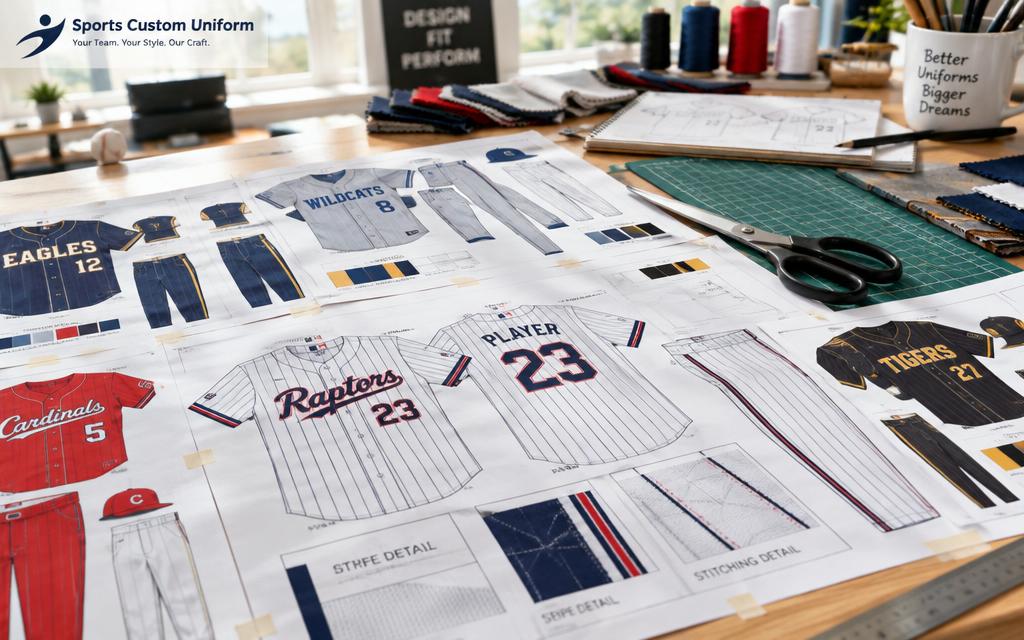
A baseball uniform pattern is a printed sewing pattern for a baseball-style shirt, and it comes with seam allowances already included, so the pieces can be cut as printed. The seam allowance is the strip of fabric between the cut edge of a piece and the line where it is sewn. That strip keeps each piece at its printed size once it is stitched.

A team can use the pattern to sew matching shirts for several players, and a family can use it for a matching look. The printed set covers men's S to LL, women's S to LL and children's sizes 4 to 10. Each page is printed on letter-size paper, so the pages must be taped together before anything is cut.
Key Takeaways
- The pattern gives a cut-ready shirt in every size from men's S to children's 10.
- Seam allowances are already included, so cut along the printed outer edge.
- Each page is letter size and must be taped together before cutting.
- One pattern can make matching shirts for a whole team.
- Sewing suits a small team that has a sewing helper.
- Custom baseball orders suit larger teams that want player names and numbers done for them.
This guide covers how to size, prepare, decorate and sew the shirt, and when ordering finished team uniforms makes more sense. Player names and numbers can be added to any shirt, so plan them before the sewing starts. Choose the size chart before buying fabric, since the bust and length of each size decide how much fabric the team will need.
Baseball Uniform Pattern Sizes and Measurements
Men's S starts at a 37-inch bust and 27-inch length, and men's LL reaches a 45.7-inch bust and 30.1-inch length. The bust figure matters most, so measure each player before picking a row. Compare the player's measurements with the table below to find the right size.

| Size | Bust (inches) | Length (inches) | Letter-size pages |
|---|---|---|---|
| Men's S | 37 | 27 | 12 |
| Men's M | 40.2 | 27.6 | 13 |
| Men's L | 43.9 | 28.1 | 14 |
| Men's LL | 45.7 | 30.1 | 15 |
The page count matters because every page must be printed and taped. A longer size takes more time at the printer and more tape to join. Women's sizes run from S, with a 35.4-inch bust and 22.6-inch length on 10 pages, up to LL, with a 43.7-inch bust and 26.4-inch length on 14 pages. Children's size 4 has a 24.6-inch bust and 15.2-inch length on 6 pages, and size 10 has a 31.7-inch bust and 20.9-inch length on 9 pages.
A child who falls between two sizes should be measured against the bust figure first, because the bust sets the fit across the chest. Length can be adjusted later with the hem. Baseball uniform pattern free downloads are available, so a team can check the sizes before it buys paper or tape.
A bust figure that is too small will pull across the chest, so the bust matters more than the length.
Measure the player's bust over the chest at its fullest point and choose the size whose bust figure is at or just above that number.
Fabric and Fit for a Baseball Shirt
Pick a fabric with some body, because a limp or very thin knit will sag at the hem and cling at the chest. The pattern recommends a fabric with a little firmness, not a thin stretch knit that clings. A firm fabric keeps the shirt looking clean through a full game.
Choosing Fabric With a Little Firmness
A firm woven cloth or a stable knit holds the shape of the sleeves and the front panel. A thin stretch knit stretches at the elbows and bags at the front panel. The difference shows most on a shirt that players wear for long innings.
Firmness does not mean stiff. A fabric that stands away from the body hides the fit of a baseball jersey design. Choose a cloth with some give, but one that returns to its shape after a pull.
Sizing Up for a Looser Fit
The pattern recommends making the shirt one size larger than the player's usual size for a slightly loose fit. The extra room gives the shoulders and arms more space to move through a swing. A close fit pulls at the arm when a player swings, and the seams can split at the underarm.
Chest measurement can move the size up or down, so a player with a broad chest may need a larger size than the usual one. A common mistake is to cut the usual size and then find the shirt pulls across the back. Test the fabric by pulling a cut strip across the grain, and if it stretches far out of shape, pick a firmer cloth for the shirt.
Printing and Assembling the Pattern Pieces
Print the file at 100 percent scale and check the one-inch test square on the first page before printing the rest. A square that measures one inch means the other pages will print at the right size. Every pattern piece depends on that scale.

- Print every page at full scale.
- Align and tape the pages along the assembly lines.
- Cut out the pieces along the outer edge.
- Lay each piece with the printed grain line parallel to the selvage.
Printing with a fit-to-page setting shrinks every piece, so the finished shirt comes out too small. The printed edge is the cut line, so no extra margin should be added. A team pattern is cut many times, so keep the taped set intact and store it flat.
Cut the front and back from a single taped set first, so a taping mismatch shows up on the cheapest fabric.
Adding Numbers and Team Marks Before Sewing
Apply every number and team mark before you sew the shirt, because a sewn seam makes a transfer harder to press flat. The pattern instructions say to add numbers or team marks before sewing. Put them on the front and back pieces while those pieces still lie flat.
Plan player names and numbers on paper for every shirt before the transfers are made. Check each spelling against the roster and mark the position of every logo. For more ideas on team identity ideas, a team can look at colors, fonts and trim before it orders transfers.
- Apply the numbers to the front and back pieces before the facing is added.
- Choose iron-on transfer sheets for a clean edge.
- Set the iron to the sheet's instruction.
- Keep the transfer's backing off the stitched edge.
Ironing a number onto a seam allowance is a common mistake, because the edge lifts after washing. Keep every transfer on the flat panel of the shirt. Press a test transfer on a scrap of the same fabric first, and check that it survives one wash before you press the whole team.
Sewing the Baseball Shirt From Start to Finish
Sew the shoulder and side seams first and press them open, because every later step depends on a flat body. The fabric must lie smooth before the bias tape or the sleeves go on. Work in a clear order from the body to the finishing details.

The order runs like this: join the body, fuse and sew the facing, attach the facing with a 3 mm seam allowance, bind the marked bias lines, hem, set the sleeves, finish the armholes and make the buttonholes. Skipping the bias binding is allowed, but then the facing must have its own seam allowance and be sewn directly to the body.
Joining the Body and Finishing the Facing
Fuse the front and back facing, then sew the facing pieces together at the shoulders. Turn the facing right side out and press it flat. Attach it to the body with the 3 mm seam allowance so the edge sits neatly inside the neckline.
Press the facing edge before the binding goes on, or the edge will not lie flat. A ridge along the neck is the usual sign that this step was skipped.
Bias Tape, Hem and Sleeves
Baste along the bias line first, then bind the edges. Fold up the hem and sew it on the machine with an even line of stitching. The sleeves get a bias finish too, which leaves only the armhole raw.
Armholes, Buttonholes and Buttons
Finish the armholes, then attach the sleeves to the body. Make the buttonholes and sew on the buttons. Check that the buttons line up with the buttonholes before stitching them in place.
Sew a practice buttonhole on a scrap of the shirt fabric before you cut one into the finished placket.
Vintage Baseball Uniform Details From the 1910s
A 1910-era baseball cap used four cap sections and a quarter-inch seam allowance around each piece. A vintage baseball uniform pattern uses the same construction as the modern one, with different materials. The historical details show what a team can copy and what it can change.
| Item | Historical material | Note |
|---|---|---|
| Bill | Stiff shaped bill piece | Cut as its own piece |
| Underbrim | Cap section | Cut with a quarter-inch seam allowance |
| Uniform fabric | Wool flannel | A firm modern fabric gives a similar look |
| Eyelet and band | Leather band with hand-worked eyelets | Optional detail and the hardest element to sew |
Wool flannel is the fabric identified as suitable for a historical baseball uniform of that period. A firm modern fabric can give a similar look, so a vintage look does not need real wool. The cap's shape comes from the cut of the pieces more than from the cloth.
The leather band and hand-worked eyelets are details a team can skip. Choose the historical wool look first, then add the leather band only if the team wants the detail, because it is the hardest element to sew.
Sewing at Home or Ordering Custom Uniforms
Home sewing makes sense for a small team with a sewing volunteer, while a larger team usually gets better results from a single order. Home sewing takes a full set of materials and time for each player. A team order puts every player on one list and one design.

When Home Sewing Makes Sense
Home sewing works best when four checks are true.
- The team is small.
- The team has a sewing volunteer.
- The team needs only one or two shirts.
- The team accepts a simple design.
A free baseball jersey designer can help a team plan colors and names before sewing, but it cannot cut the pieces. The cutting and the sewing still fall to the team.
When a Team Order Makes More Sense
One list keeps every player's names, numbers and sizes together, and a custom order leaves the cutting to the maker. A custom baseball order also keeps the design the same for every shirt. Youth baseball uniforms packages make sense when a team has a wide range of children's sizes, and children's sizes 4 to 10 need separate cutting.
Count the total shirts, the sewing hours and the fabric before you decide, because a half-finished home run wastes the whole set.
Team Orders, Packages and Reorders
A custom team order usually takes several weeks from approved design to delivery, so the team list should be ready before the design is approved. Busy spring weeks can add more time. The steps below show what the team provides at each point.

| Step | What the team provides | Typical timing |
|---|---|---|
| Team list | Player names, numbers and sizes | Ready before design approval |
| Design approval | Final colors, logos and names | Before production starts |
| Production | Nothing beyond the approved design | Several weeks, longer in busy spring weeks |
| Delivery | Confirmed address and shirt count | At the end of production |
| Reorder | Name, number and size of the new player | Usually a new run |
A minimum order quantity can apply to a custom run, so ask about it before the design is approved. Custom baseball uniforms packages bundle the shirt, names and numbers into one price. Custom baseball jerseys at a lower cost depend on the quantity, so ask the maker for a price at several quantities.
Baseball uniforms near me can be found by asking a local maker for a fabric sample. The sample shows the color and weight before the team commits to a design.
One order for the whole team usually costs less per shirt than several small orders.
Ask for the minimum order quantity and the reorder process in writing before the design is approved, so a late player can be added at the same size.
Conclusion
A baseball uniform pattern works best for a small team with a sewing volunteer and a clear size chart. The pattern gives a cut-ready shirt in every size, from men's S to children's 10. A team can choose between sewing and ordering based on the number of shirts and the sewing help it has.
A team with many players and no sewing help should order the shirts instead. That choice keeps the cutting and the sewing off the volunteers.
Measure every player's bust this week and send the list to the maker or the team sewer before the season starts.
FAQ
How much fabric does a baseball shirt pattern need?
An adult shirt usually needs about 2 to 2.5 yards of 60-inch fabric. The exact amount depends on the size, so check the size chart before you buy. Add a little extra for cutting, because every piece must lie with the grain line in the right direction. A larger size uses more fabric, so buy for the biggest player on the team.
Can I print the pattern at a copy shop?
Yes, print it at 100 percent scale on letter-size paper. Men's sizes run from 12 to 15 pages, and children's sizes run from 6 to 9 pages. Ask the shop to print at actual size so no page is resized. Tape the pages together before cutting, and keep the set flat so the lines stay straight.
Do I need to add seam allowances to the pattern pieces?
No, the seam allowances are already included. Cut each piece along its printed outer edge. Adding extra fabric changes the finished size and can make the shirt too big. Check the front and back against each other after cutting so they match at the shoulders.
Can a girl or a child use the same pattern?
Yes, the pattern includes women's sizes S to LL and children's sizes 4 to 10. Choose the size by bust measurement, not by age. A child between sizes should be measured at the bust first. Keep the size chart with the printed pieces so the right row is easy to find later.
Is home sewing cheaper than a custom order?
Home sewing can cost less per shirt for a few players, but the result depends on fabric, printing and sewing hours for each shirt. The team pays for the fabric and printing when it sews at home. A custom order carries the maker's setup cost and may have a minimum order quantity. Count the sewing hours for each shirt before you compare totals.
How long does a custom team order take?
A custom team order usually takes several weeks from approved design to delivery. Busy spring weeks can take longer. Approve the design and the team list at least several weeks before the first game. Make sure the names and numbers are final before approval, since late changes can hold up production.
Can a team reorder the same uniforms later?
Yes, a team can usually reorder the same design for a new player. Keep the team list with names, numbers and sizes, so a reorder matches the shirts already worn. A new player can then get the same colors, logos and sizing as the rest of the team.


