

Cart
0
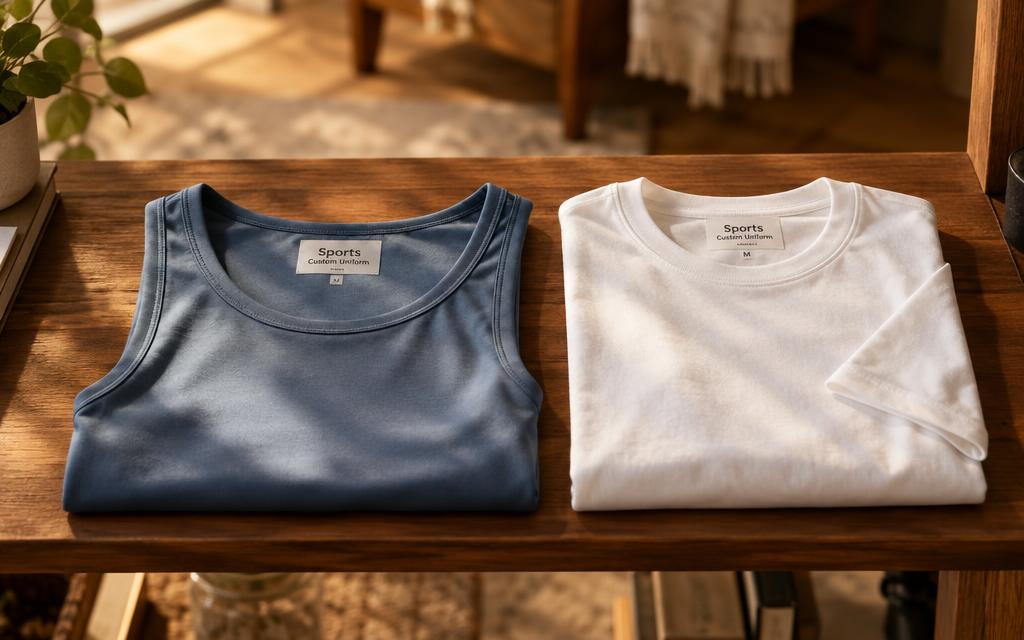
A tank top has no sleeves, and a T-shirt has short sleeves that cover the shoulders. That one difference drives most of the choice between them. A tank top wins for heat, workouts and layering, while a T-shirt wins for sun cover, office wear and everyday style.
Think about a hot afternoon when a shirt sticks to your back. Sleeves trap heat around your arms, and a sleeveless shirt lets air move across your skin. That is why the choice matters for comfort, sweat and fit. A sleeveless shirt also means more sun exposure on bare shoulders.
A muscle tee sits between the two. It drops the sleeves but keeps a full shoulder seam. Pick the tank for heat and free arm movement, and the T-shirt for sun cover and polished settings.

Key Takeaways
- A tank top is sleeveless, while a T-shirt has short sleeves over the shoulders.
- Tank tops keep you cooler and let your arms move freely.
- T-shirts give better sun cover for the shoulders and upper arms.
- A muscle tee is a sleeveless T-shirt with a full shoulder seam.
- Fabric affects comfort as much as the cut does.
- Test any top by reaching overhead and twisting before you buy.
What Separates the Two Garments
The T-shirt gets its name from the T shape made by its body and sleeves. Most people now shorten it to tee, and both words describe the same short-sleeved shirt with a round crew neck. A T-shirt is the baseline for this comparison.
The U.S. Navy issued short-sleeved, crew-necked white cotton T-shirts as undershirts in 1913. The word T-shirt had entered American English by the 1920s. In the 1950s, T-shirts became fashionable as standalone outerwear. In the 1990s, a tank top over a T-shirt was one layering look among many, while a white tee under a slip dress showed how far the tee had moved into fashion.
A T-shirt has short sleeves and a round crew neck. A tank top has no sleeves at all.

Expect a T-shirt to be cotton jersey in most stores, which is why it stretches and drapes softly.
How Coverage, Armholes and Neckline Differ
A tank top shows more of the body than a T-shirt because its armholes are cut deep into the side. The straps leave the shoulders bare. A T-shirt covers the upper torso and the upper arms with a full sleeve.

Armhole depth and shoulder cover
A tank top has narrow straps and deep armholes, so air reaches the side of the body. Tank tops are usually buttonless, collarless and pocketless. A deep armhole shows more side torso, so it may not suit every workplace. For a side-by-side look at how a tank tops and T-shirts for summer sports comparison plays out on the field, the cut matters more than the color.
| Garment | Shoulder cover | Armhole | Typical neckline | Airflow |
|---|---|---|---|---|
| Tank top | Straps only | Deep and narrow | U or V | Highest |
| Muscle tee | Full shoulder seam | Wide and deep | Usually crew | High |
| T-shirt | Full shoulder and upper arm | Standard, set by the sleeve | Usually crew or V | Moderate |
Neckline shape and men's versus women's cuts
Tank tops usually have a U or V neckline. Men's tank tops often have larger armholes and neck openings than women's tank tops. On some men's tanks, the neck opening can reach the bottom of the chest. A men's tank top is the choice for heat, but it shows more chest and side than a T-shirt does.
Which tank top vs T-shirt is better for men depends on the setting. For most men, the T-shirt is better for sun cover and office wear, while a men's tank top is better for heat and the gym.
Check the armhole edge first when comparing tanks, because a cheap cut gapes and rolls after washing.
Where Tank Tops and Muscle Tees Come From
A muscle shirt is a tank top's close cousin, but it keeps the shape of a T-shirt without the sleeves. Its full shoulder seam is the clearest sign of the difference. The muscle shirt also goes by the name muscle tee.

The tank name and its 1920s origin
The name tank top comes from the tank suit, a one-piece bathing suit worn in swimming pools in the 1920s. The sleeveless shape of that suit gave the shirt its name. In the United States, a casual sleeveless shirt can be called a tank top or a tank shirt.
The muscle tee as a middle option
Is a tank top a muscle shirt? No. A muscle shirt is a sleeveless T-shirt, so it is a muscle tee and not a tank top. It has the design of a T-shirt with the sleeves cut away.
Buyers can tell the two apart by feeling for a shoulder seam. Look for a shoulder seam on a muscle shirt, because a tank top has none.
Wearing a Tank Top Under a T-Shirt
A tank under a shirt is a thin second layer that absorbs or moves sweat before it reaches the outer fabric. It adds a layer against the skin without adding sleeve bulk. A tank top undershirt is most useful when the outer shirt is thin or the day is warm.

A sweat-wicking tank can help keep the outer shirt drier. A cotton tank mostly absorbs moisture instead, so it may feel damp by the end of the day. Wear a tank under a shirt when you know you will sweat, or when the outer layer is sheer.
- Under a dress shirt at work, to keep sweat off the fabric.
- Under a thin white tee, so the tee does not show sweat marks.
- Under a sheer top, to add modest coverage.
- Under a blazer on a hot day in a warm room.
A bulky tank shows at the neckline, so choose a fitted tank that matches the shirt's neckline.
Fabric, Sweat and Airflow in Each Garment
Fabric decides how fast sweat leaves the skin, and that matters more on a hot day than the cut. Cotton holds sweat, while synthetic performance fabrics move sweat outward. Blends fall somewhere in between.

Why cotton holds sweat
MedlinePlus advises quick-drying, sweat-wicking fabrics for exercise. It notes that cotton absorbs sweat and dries slowly. A heavy cotton tee holds sweat longer than a light synthetic tank, because it carries more fabric against the skin.
| Fabric | What it does well | Where it falls short |
|---|---|---|
| Cotton | Soft and familiar, good for low-sweat days | Holds sweat and dries slowly |
| Synthetic performance fabric | Moves sweat outward and dries fast | Can feel less natural to some wearers |
| Blend | Balances feel and drying speed | Results depend on the blend and knit |
Synthetic and blend fabrics for activity
A sports tank in a sweat-wicking fabric dries faster than a cotton tee. Look for quick-drying labels on tank tops for training. Mesh panels add more airflow on hot practice days.
Read the fabric label before choosing, because cotton feels heavy by the end of a hard session.
Which Garment Fits Sun, Heat and Workouts Best
A tank top is the cooler choice on a hot day, while a T-shirt is the better shield from sun. The tank leaves the arms and shoulders open for full air circulation. The T-shirt covers the shoulders and upper arms on a warm, bright day.
For workouts, the tank gives free arm movement for overhead lifts and rowing. A T-shirt can feel restrictive during those moves. In a dressier office, the T-shirt usually looks more polished than a tank.
In the UK, a sleeveless undershirt is called a vest. Australia and New Zealand call it a singlet, and the T-shirt keeps its own name in every country.
On a sunny outdoor day, apply sunscreen to bare shoulders when you wear a tank.
How to Test Fit Before You Buy
Test a top by moving in it, because a shirt that looks right on a hanger can still pinch or gape. Fit should allow overhead reach, twist and squat without pinching, pulling or riding up. Too tight limits movement and causes chafing, while too loose can drag or get in the way.
The movement test for a tank top
Stand in front of a mirror and raise both arms overhead. Twist slowly from the waist, then squat. Watch the armhole, because a tank's weak point is where the armhole meets the side of the body.
Swing your arms forward and back. If the armhole gapes or the neckline drops, the cut is too loose for training.
The movement test for a T-shirt
Repeat the same reach, twist and squat with a T-shirt. Check the sleeve, because it should not pull or bind at the upper arm. Look at the hem, which should stay in place when you bend.
Use the list below as your checklist in the fitting room.
- Reach overhead and check that the shoulders do not pull.
- Twist at the waist and check that the hem stays down.
- Squat and check that the top does not ride up.
- Swing both arms and check that the armhole or sleeve does not chafe.
Fit comes before style. A top that pinches, pulls or rides up will not last a workout.
Check the fabric in bright light for see-through patches before you commit.
Conclusion
Buy a tank for heat and free arms, and a T-shirt for sun cover and dressier settings. A muscle tee sits in the middle, which makes it a good pick for lifting.
Start with one tank for training and one T-shirt for daily wear, then add to the set once you know how each one fits your comfort needs.
FAQ
What is the difference between a tank top and a T-shirt?
A tank top is sleeveless and has narrow straps, while a T-shirt has short sleeves that cover the shoulders and upper arms. The tank leaves the shoulders bare, so air moves across the skin more easily. The T-shirt gives more sun cover. Choose the tank for heat and workouts, and the T-shirt for sun and office wear.
Is a tank top or a T-shirt better for working out?
A tank top is usually better for working out in heat, because it gives free arm movement for overhead lifts and rowing. A T-shirt is better when sun exposure is a concern on outdoor days. Fabric matters more than either cut. A sweat-wicking synthetic tank dries faster than a cotton tee, so check the label before you buy.
Can you wear a tank top under a T-shirt?
Yes, a fitted tank adds a thin layer under a T-shirt without adding sleeve bulk. A sweat-wicking tank can keep the outer shirt drier on a hot day. A cotton tank mostly absorbs moisture instead. Pick a tank that matches the shirt's neckline, so the straps and collar do not show.
Is a muscle shirt the same as a tank top?
No, a muscle shirt is a sleeveless T-shirt with a full shoulder seam, while a tank top has narrow straps and no seam. The muscle shirt keeps the crew neck and wide armholes of a regular tee. Check the shoulder to tell them apart. A tank top has no shoulder seam at all.
What do other countries call tank tops?
Australia and New Zealand call a tank top a singlet. In the UK, a sleeveless undershirt is often called a vest. The names are regional, so a shop in another country may use a different word. Look at the picture and the straps to confirm the style you want.
Why are T-shirts called tees?
Tee is the short form of T-shirt, and the name comes from the T shape the body and sleeves make. The U.S. Navy issued white cotton T-shirts as undershirts in 1913. Most people now say tee shirt or tee for the same short-sleeved style. The shorter word is common in both stores and everyday talk.


