
Cart
0
When the Denver Broncos unveiled their 1977-inspired orange and blue throwback look in 2024, fans immediately embraced the return to franchise history. The Philadelphia Eagles' Kelly green uniforms have created similar excitement since returning to the rotation.
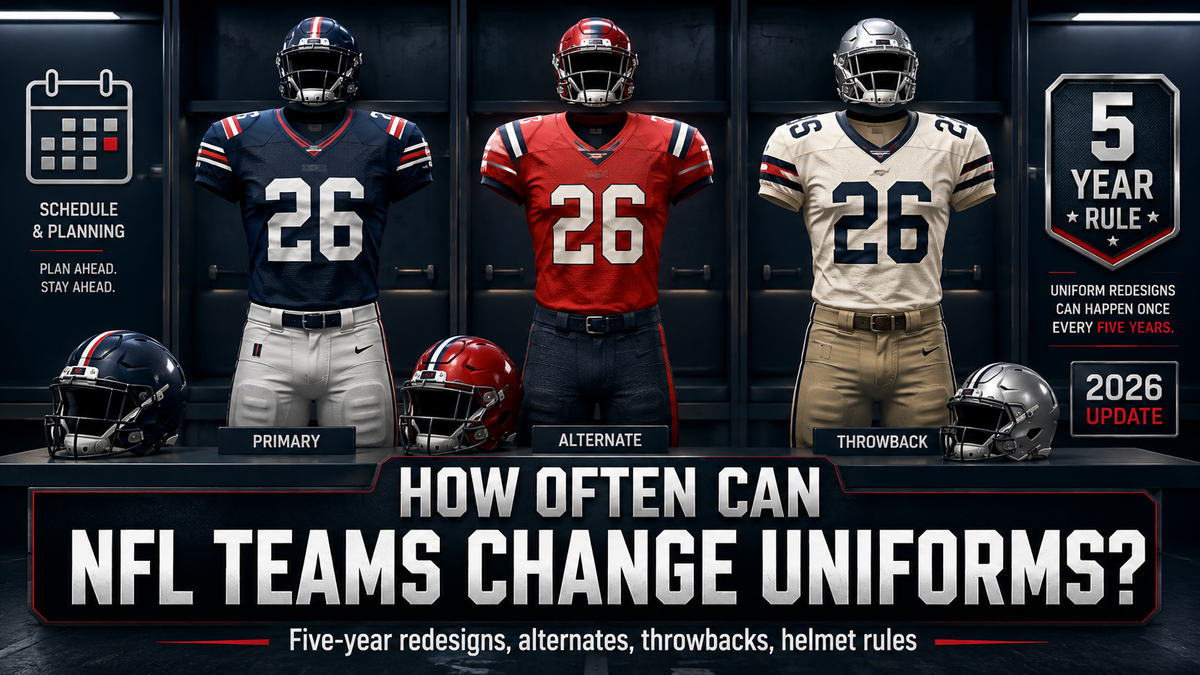
Moments like these raise an interesting question: how often can NFL teams change uniforms?
The answer depends on what type of change you're talking about.
A complete redesign of a team's primary uniform follows a much stricter timetable than wearing an alternate or throwback jersey. Helmet options operate under another set of rules, while the NFL's new Rivalries program has introduced an additional layer of uniform flexibility.
The league's approach attempts to balance long-term franchise identity with fresh designs, player safety, merchandise demand, and fan interest.
This guide explains the current rules, including what changed for the 2025 and 2026 seasons.
Key Takeaways on NFL Uniform Rules
- Primary redesigns: NFL teams generally operate on a five-year cycle for major permanent uniform redesigns.
- Alternate and throwback jerseys: Beginning in 2025, teams can wear them a combined four times during the regular season, up from three.
- Helmet options: All 32 teams can use up to three helmet designs beginning with the 2025 season, subject to NFL approval and safety requirements.
- Helmet pairings: The current rules provide more flexibility than the earlier system that restricted alternate helmets only to optional uniforms.
- Rivalries uniforms: Nike x NFL Rivalries designs remain in participating teams' uniform lineups for three years after introduction, in addition to existing alternates.
- Playoffs: Primary jerseys remain required, although alternate pants now have greater postseason flexibility.
- Super Bowl: Normal alternate and throwback jerseys are not used as the team's championship-game jersey designation under current postseason rules.
- Safety: Alternate helmets must satisfy fit, model, sizing, and practice requirements.
The NFL's Five-Year Uniform Redesign Rule
The foundation of NFL uniform policy is commonly known as the five-year rule.
Teams that make a substantial permanent change to their primary uniform identity generally operate on a five-year redesign cycle. In practice, a franchise cannot simply introduce a completely different primary uniform set every season.
Recent uniform-industry reporting in 2026 continues to describe NFL clubs as being permitted to make major uniform changes on a five-year cycle.
This applies to major changes involving the core visual identity of the uniform rather than every minor adjustment.
A complete redesign can involve elements such as:
- Primary jerseys
- Pants
- Number styling
- Striping
- Color treatments
- Helmet design
- Logos or secondary marks
- Overall uniform architecture
Teams work through a league approval process when introducing a major redesign.
The five-year window helps preserve visual consistency. Fans have time to associate a particular look with an era of the franchise instead of seeing the team's identity change every season.
Long-running uniforms from teams such as Pittsburgh and Dallas demonstrate why visual continuity can become an important part of franchise recognition.
Examples of Major NFL Uniform Redesigns
The 2024 season provided several notable examples.
The Denver Broncos, Houston Texans, New York Jets, and Detroit Lions all introduced significant uniform changes or new primary systems.
These releases showed how franchises can modernize without completely abandoning their history.
A redesign might introduce:
- New typography
- Updated striping
- More flexible pants combinations
- Historical color references
- New secondary logos
- Alternate helmet options
- Modern uniform materials
The goal is usually to evolve a recognizable identity rather than create change simply for novelty.
Alternate and Throwback Uniforms: More Flexibility Than Primary Redesigns
The five-year cycle does not mean an NFL team must look exactly the same in every game for five years.
Alternate and throwback uniforms operate under a different policy.
Beginning with the 2025 season, NFL teams were permitted to wear alternate or throwback jerseys a combined four times during the 17-game regular season.
The previous maximum was three.
The Denver Broncos confirmed the league change following the 2025 NFL Annual Meeting.
NFL alternate and throwback uniform rule update
The four-game limit allows franchises to create more visual variety while ensuring the primary home and road uniforms remain the team's dominant identity.
What Is an Alternate Uniform?
An alternate uniform is an approved secondary look that differs from the normal home or road set.
Examples may include:
- Different jersey colors
- Color Rush-inspired combinations
- Alternative pants
- Special helmet pairings
- Secondary branding
What Is a Throwback Uniform?
A throwback, or classic uniform, recreates or closely references an earlier era in the franchise's history.
Popular examples include:
- Philadelphia's Kelly green
- Tampa Bay's creamsicle look
- Denver's orange-and-blue throwbacks
- New England's red throwbacks
Throwbacks allow teams to reconnect modern players and fans with historic franchise identities without permanently replacing the current uniform.
The 2026 Nike x NFL Rivalries Program Adds Another Layer
Uniform policy became even more interesting with the introduction of the Nike x NFL Rivalries program.
The program launched in 2025 with teams from the AFC East and NFC West.
For 2026, NFL and Nike introduced Rivalries uniforms for teams from the AFC South and NFC North, while teams that debuted Rivalries looks in 2025 can bring them back for selected divisional rivalry games.
The NFL says each new Rivalries uniform remains in that team's uniform lineup for three years after its debut, in addition to existing alternate uniforms.
See the official 2026 NFL Rivalries uniform update
The program is scheduled to continue expanding through additional divisions in 2027 and 2028.
This means the modern answer to how often can NFL teams change uniforms is more nuanced than simply saying "once every five years."
The five-year cycle applies to major primary redesigns, while alternate, classic, helmet, and special programs give teams additional ways to change their appearance.
Helmet Regulations: From One Shell to Three Designs
NFL helmet policy has changed dramatically over the last several years.
For roughly a decade, the league used a one-shell rule. Teams were generally limited to one helmet shell throughout a season.
That restriction prevented several historically accurate throwback uniforms from returning because the old uniforms required a helmet color different from the team's primary helmet.
The NFL relaxed the policy beginning in 2022 by allowing alternate helmets.
It expanded the rule again in 2024.
How Many Helmets Can NFL Teams Use Now?
Teams undergoing redesigns for 2024 received access to a third helmet option first.
Beginning with the 2025 season, all 32 NFL teams became eligible to use up to three helmet designs.
Important 2025 Helmet Flexibility
The original draft says alternate helmets can only be paired with classic, alternate, or Color Rush uniforms.
That reflected the earlier policy but is no longer a complete description.
The 2025 uniform-policy refresh added more flexibility in certain helmet-and-jersey combinations. Denver, for example, confirmed that the updated policy allowed the club to pair its alternate white helmet with its primary orange jersey.
So the safer current rule is:
Teams have more helmet-combination flexibility than before, but every helmet and uniform combination must still fall within the club's league-approved uniform options.
Helmet Safety Requirements Still Apply
Alternate helmets are not simply cosmetic props.
NFL policy requires alternate helmets to meet important fit and preparation conditions, including:
- An entire alternate set for applicable players
- Same make, model, and size as the player's primary helmet
- Proper fitting
- Availability during training camp
- Practice use before the helmet is worn in a game
These requirements are intended to preserve consistent fit and player safety.
Special Circumstances and Playoff Uniform Rules
NFL postseason rules are stricter than regular-season uniform rules.
Teams have greater freedom during the regular season to use approved alternates, throwbacks, helmets, and pants combinations.
The postseason places more emphasis on primary visual identities.
Can NFL Teams Wear Alternate Jerseys in the Playoffs?
Postseason designation rules require teams to use their primary jersey color, which prevents normal alternate or throwback jerseys from being used as postseason jersey choices.
A 2025 policy adjustment did, however, give teams more flexibility with alternate pants during the playoffs.
Can Teams Wear Throwback Jerseys in the Super Bowl?
Under the current postseason framework, teams cannot simply choose a normal alternate or throwback jersey for the Super Bowl.
The league wants its championship participants represented in their approved primary look.
This is why a fan-favorite regular-season alternate may disappear once the postseason begins.
The Business Side of NFL Uniform Changes
Uniform policy is not only about aesthetics.
There is a major commercial side to the decision as well.
Nike and the NFL extended their long-standing partnership through 2038, with Nike continuing as the league's exclusive provider of uniforms and key on-field apparel.
Alternate jerseys, throwbacks, helmets, and Rivalries uniforms also create new merchandise opportunities.
Fans who already own a primary jersey may still purchase:
- Throwback jerseys
- Rivalries jerseys
- Alternate jerseys
- Special helmets
- Matching sideline apparel
The 2026 NFL Rivalries announcement says the program's first-year 2025 launch became Fanatics' best-selling merchandise release to date, demonstrating how strongly special uniform concepts can connect with fans.
At the same time, teams cannot change their primary identity every time a new merchandise opportunity appears.
That tension helps explain why the NFL combines a restrictive primary-redesign cycle with more flexible secondary uniform options.
How Your Team Can Approach Custom Football Uniforms
NFL franchises must work inside detailed league rules.
Youth programs, recreational leagues, schools, amateur organizations, flag football teams, and independent clubs generally have much more creative freedom, subject to their own league requirements.
That gives non-NFL teams an opportunity to take inspiration from professional uniform strategy without copying professional branding.
Teams can explore custom football uniforms from Sports Custom Uniform to compare football-specific uniform options, materials, cuts, and customization choices.
Sports Custom Uniform's football range uses performance-oriented polyester, stretch materials, reinforced high-stress seams, and sublimated customization designed for football movement and contact.
Building Your Custom Uniform Program
When planning a team uniform system, consider:
-
Primary identity
Choose the look that will represent your team most often. -
Home and away contrast
Make sure both sets remain easy to distinguish. -
Alternate design
Consider one additional look rather than redesigning everything constantly. -
Historical elements
Older colors, logos, striping, or typography can inspire a throwback-style uniform. -
Player fit
Football jerseys need enough room for protective equipment and position-specific movement. -
Material durability
Shoulders, seams, pants, and other high-stress areas need construction suited to contact play. -
Names, numbers, and logos
Make identification clear before adding decorative complexity. -
Long-term consistency
A design that still feels recognizable in several seasons can build a stronger identity than constantly changing artwork.
For a complete football package rather than separate pieces, teams can review the Custom Football Team Uniform Package Pro.
The current football packages collection lists the Pro package alongside All-Star and Diamond Pro options.
What NFL Uniform Rules Can Teach Smaller Teams
The NFL's system provides a useful branding lesson even for organizations that do not have NFL-style restrictions.
A team does not need a completely new identity every season to remain interesting.
Instead, consider a hierarchy:
Primary Uniform
Your most recognizable long-term look.
Away Uniform
A high-contrast variation that still clearly belongs to the same visual system.
Alternate Uniform
An opportunity for more creativity without replacing the team's core identity.
Throwback or Heritage Uniform
A design that connects the current team to an earlier era.
Special-Event Uniform
Used sparingly for rivalry games, anniversaries, charity events, tournaments, or major milestones.
This approach allows creativity without turning the team's branding into a collection of unrelated uniforms.
Sports Custom Uniform's previous guide Top Trends in Team Uniform Design for 2026 explores retro patterns, high-contrast minimalism, sublimation, modern fit, and other current design directions.
For the historical side of the same topic, The Evolution of Sports Uniforms: From Basic to Fully Custom Designs explains how team uniforms moved from simple traditional clothing to modern performance fabrics and fully customized designs.
These are the two previous relevant blogs linked semantically to the current topic.
Designing Your Team's Uniform Strategy
Whether you're building uniforms for a youth football organization, school team, amateur league, or semi-professional program, professional uniform policies provide a useful lesson:
change can be exciting, but consistency builds identity.
Your organization may be free to redesign every season, but that does not always mean it should.
Think about:
- Core team colors
- Historical identity
- Number visibility
- Logo consistency
- Player comfort
- Protective-equipment fit
- Uniform durability
- Home and away contrast
- Alternate designs
- Production and replacement costs
The strongest uniform strategy usually gives the team a recognizable foundation and then uses alternate designs for controlled creativity.
If your organization wants to build that system, Sports Custom Uniform offers custom team uniforms across football and other sports, including personalized colors, logos, names, numbers, fabrics, and digital design support.
Conclusion
So, how often can NFL teams change uniforms?
For a major permanent redesign, teams generally work within a five-year cycle.
But that is only one part of the modern uniform system.
Since 2025, clubs have been able to wear approved alternate or throwback jerseys up to four regular-season games. Teams can also use as many as three helmet designs, with more combination flexibility than under the earlier one-shell system.
The Nike x NFL Rivalries program has added yet another option. In 2026, participating teams are debuting community-inspired Rivalries uniforms that remain in their lineup for three years alongside existing alternate looks.
The result is a carefully layered system:
primary redesigns change slowly, while alternates, throwbacks, helmets, and special programs provide controlled variety.
That balance helps the NFL preserve recognizable franchise identities while still giving fans and teams something fresh to look forward to.
Frequently Asked Questions
If a team changes uniforms in 2024, when can it make another major redesign?
Under the five-year redesign cycle, 2029 would generally be the earliest point for another major primary redesign.
Minor adjustments, approved alternates, throwbacks, helmet combinations, and special programs are different from replacing the entire primary uniform system.
Can NFL teams wear throwback uniforms as often as they want?
No.
Beginning in 2025, NFL teams can wear alternate and throwback jerseys a combined maximum of four times during the 17-game regular season.
Why does the NFL restrict uniform changes while college teams change more frequently?
The NFL places substantial value on franchise branding, visual consistency, licensing, and long-term identity.
College programs operate under different conference, institutional, supplier, and branding structures, so they often have more freedom to rotate designs.
Do NFL teams have to use the same helmet throughout the season?
No.
Beginning in 2025, all 32 clubs became eligible to use up to three helmet designs, subject to NFL uniform and safety requirements.
Can players request a specific uniform combination during a winning streak?
Players may have preferences, but individual players do not independently decide the team's weekly uniform.
The club's selected combination must remain within its approved uniform options and league rules.
What happens if an NFL team violates uniform rules?
NFL Football Operations monitors uniform compliance.
Teams and players are expected to follow approved equipment and appearance requirements, and violations can lead to league enforcement or penalties. NFL uniform inspectors also review player equipment and appearance on game day.
Are vintage uniforms automatically eligible as official throwbacks?
Not automatically.
A historical design still needs league approval, and historically inspired helmet designs must follow applicable compatibility and safety rules.
Teams cannot simply introduce an unofficial "vintage" jersey on game day without approval.
Why must alternate helmets meet the same fit and model requirements?
Player safety and consistent helmet fit.
NFL policy requires an alternate helmet to be the same make, model, and size as the applicable player's primary helmet and to be used in practice before game use.
Can an NFL team use a fourth helmet?
Not under the current three-helmet framework.
All teams gained access to a third helmet option beginning in 2025. A fourth helmet would require another policy expansion.
What's the purpose of the five-year uniform rule?
The cycle helps preserve:
- Franchise recognition
- Long-term brand consistency
- Historical continuity
- Fan familiarity
- A clear distinction between permanent redesigns and occasional alternate looks
It gives teams room to evolve without turning the primary identity into an annual redesign project.


