

Cart
0
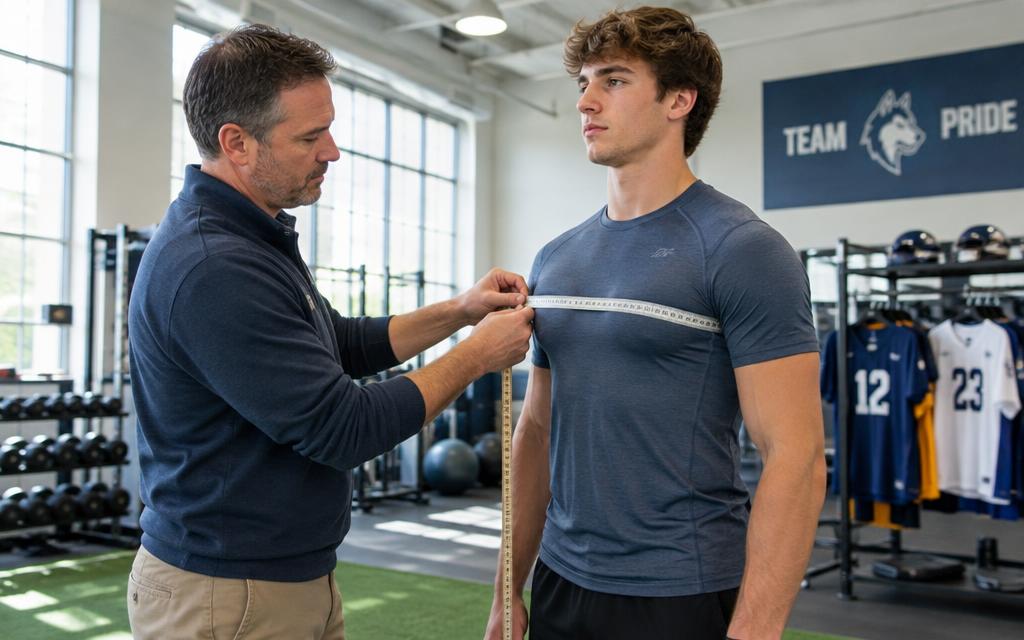
A size letter on a jersey tag is only a label, and the size chart behind it decides whether the athlete fits. Two brands can print the same letter and cut it to very different measurements.
Many parents have held a jersey that looked right on the rack and felt wrong on the field. The sleeves hung low, or the chest pulled tight across the shoulders.
Sizing gets harder when youth and adult charts are mixed up. The three body measurements that matter most for a jersey are chest, waist and length. Youth and adult charts use separate ranges for these numbers.
Measurements are more reliable than letters. A soft tape gives you the numbers in a few minutes. You will learn how to take each one and how to read the chart row that matches it.
Key Takeaways
- A size letter such as M or XL means different things from brand to brand.
- A size chart lists the body ranges for each size, so read the exact row.
- Take the chest, waist and length of the athlete with a soft tape.
- Youth and adult charts use separate ranges and never swap.
- Ease is the extra room a garment allows so the athlete can move.

Measure the athlete before ordering, since a measurement taken today beats a size remembered from last season.
What a Size Letter Really Means
A medium in one brand can fit like a large in another, because each brand builds its sizes from its own own size chart. The letter is a name the company picks. The numbers behind the letter are what matter for sizing.
Take two real examples. A medium from Endura lists a chest of 39-41 inches. A medium from Nike lists a chest of 96-104 cm, which is about 37.8 to 40.9 inches. The letter is the same, but the chests are not.
Ease is the extra room a garment allows beyond the body measurement so the athlete can move and breathe. Every garment is cut with some ease, and the amount changes by brand and by style.
Why the Same Letter Differs by Brand
Each brand picks its own range for each letter. One company may set medium at a chest of 39-41 inches, while another sets it lower or higher. A buyer who trusts the letter alone can end up with the wrong jersey.
Why Youth and Adult Charts Do Not Match
Youth and adult charts use separate ranges. A youth medium does not match an adult small, even when the labels look alike. Always read the chart for the group the athlete belongs to.
Why Ease Matters
Ease matters because a body moves. A jersey cut to the exact chest measurement pulls across the shoulders when the athlete swings or reaches. Extra room keeps the fabric from binding during play.
Check three things on any size chart:
- Chart source: the brand's own table for that exact garment.
- Unit: inches or centimeters, and whether both are listed.
- Measurement type: a body measurement or a garment measurement.
A non-stretch garment needs at least 2 inches of ease over the body chest measurement.
A chart that lists flat garment widths needs a different reading than one that lists body ranges. Mixing the two is a common reason a jersey arrives too small.
Check the chart for the exact garment, since a chart for a different style of shirt can mislead.
Measure the Athlete, Not the Tag
Stand the athlete relaxed, with the arms slightly away from the body, and wrap the tape at the fullest part of the chest. Keep the tape level all the way around the body.
Use a soft tape, not a metal one. The tape should stay snug, not tight, so it lies flat against the skin without squeezing. Measure over light clothing, such as a thin t-shirt, never over a hoodie or a coat.
To measure a child for a jersey, take the chest and waist first, then add the length if the chart lists it.

Chest and Waist Steps
For the chest, keep the tape level with the floor at the fullest part. For the waist, find the natural waist, about 1 inch above the belly button.
Breathe normally during the chest reading. Do not hold the breath, since a held breath makes the chest look bigger than it is.
Hips, Inseam and Length
Each body measurement has its own spot on the body. The list below shows where the tape goes for each one.
- Chest: the fullest part, level with the floor.
- Waist: the natural waist, about 1 inch above the belly button.
- Hips: the fullest part of the seat.
- Inseam: from the crotch down to the desired hem.
When a number falls between two sizes, Nike advises the smaller size for a tighter fit or the larger size for a looser fit.
Measuring with a Flexible Tape
Hold the tape flat and keep it parallel to the floor. Ask the athlete to stay still for each reading, since a shifting shoulder can change the number. Football teams can compare these numbers with a custom football jersey fit guide before ordering.
Common Tape Mistakes
The most common mistake is measuring over a thick sweatshirt. The second is letting the tape sag or twist, which throws off the number. If the chart is in centimeters, convert the number to inches before comparing. Write each number in inches right away, so a forgotten figure never becomes a guessed size.
Reading an Adult Men's Size Chart
A chest of 40 inches falls in the Endura medium row, and the waist decides only when the two rows disagree. Start with the chest, because it sets the main fit.
Read a men's chart as ranges, not single numbers. A row that says 39-41 inches covers every measurement from 39 to 41. A chest of 40.5 inches still belongs in that row.
Endura lists four men's jersey rows in inches. Each row gives a chest range and a waist range.
| Size | Chest (inches) | Waist (inches) |
|---|---|---|
| XS | 35-37 | 29-31 |
| M | 39-41 | 33-35 |
| XL | 43-45 | 37-39 |
| 3XL | 47-49 | 41-43 |
Nike uses centimeters for its men's tops. A Nike medium lists a chest of 96-104 cm, and a Nike large lists 104-112 cm.
Men's jerseys in sports often cut close through the body. A row that fits the chest can still feel snug at the waist. Compare the chest first, since a jersey is built around the chest, and use the waist only when the rows disagree.
Women's and Youth Charts Compared
A girl aged ten can fit a different row than her classmate, so the chest measurement decides the youth size. Women's and youth rows do not follow the men's rows.
Many brand tables list women's and youth sizes in centimeters. The numbers are different from the men's rows, so never swap sizes without reading the chart.
Women's cuts run narrower in the shoulders and taper at the waist. Nike lists its women's tops by bust and waist, as shown below.
Women's Bust and Waist Ranges
| Size | Bust (cm) | Waist (cm) |
|---|---|---|
| S | 83-90 | 67-74 |
| M | 90-97 | 74-81 |
| L | 97-104 | 81-88 |
A women's medium is not a unisex medium. Check the women's row even when the athlete wears a men's shirt.
Youth Chest and Waist Ranges
Nike's boys' youth tops list a chest of 69-75 cm for size M and 75-81.5 cm for size L. Its girls' youth tops list 73-79 cm for size M and 79-85.5 cm for size L.
Age labels are weak guides, so do not rely on them alone. Two checks work better:
- Height: match the athlete's height to the range on the chart.
- Chest: take the chest with a tape and match it to the row.
Gray reflects heat better than black, and all-black uniforms can add to overheating in youth play. Look at color options for baseball uniforms before you order.
Let the athlete try both cuts when possible, since the fit feels different.
Big Boys and Big Girls Sizing
A boy who stands 60 inches tall with a 34-inch chest belongs in the large row. The height and chest together show the fit more clearly than either one alone.
Big boys and big girls rows use height and chest to show the fit. Each row also gives a numeric size, which is often easier to remember than a letter.
Nike's big boys size M matches numeric size 10-12, ages 10-12, and a height of 55-60 inches. For big boys size M, check three things:
- Height: 55-60 inches.
- Chest: 30.75 inches.
- Numeric size: 10-12.
The big girls size M row lists a height of 57-63 inches, a chest of 30.75 inches and numeric size 10-12. The big boys size L row lists numeric size 14-16, a height of 60-65 inches and a chest of 34 inches.
Big boys rows also list a waist, so compare it with the hips before you choose.
Confirm height as well as chest, since a tall, lean child may need the next size for length.
Fit Checks and Hip Measurements
When the waist points to one size and the hips point to a larger one, the hip measurement decides the pants. A pair that fits the waist but not the hips will ride down or pull at the seat.
Hips are the widest part of the lower body, so they set the room a pair of pants needs. Football and wrestling need different fit choices, and both are covered below.
Hips When the Waist Points Elsewhere
Take an example. An athlete has a waist of 30 inches and hips of 36 inches. The waist row says a medium, but the hip row says a large, so the large is the better choice for pants.
Stretch fabric gives some room, so the hip number matters less. A non-stretch pair needs the hip number to match closely.
Jersey Over Pads
Football jerseys are usually ordered one to two sizes up from the athlete's t-shirt size so they fit over shoulder pads. The pads add bulk that a plain shirt does not have.
Two sport cases are worth knowing:
- Football: order one to two sizes up, so the jersey clears the pads.
- Wrestling: a singlet fits snug, so a loose feel means the size is too large.
Basketball jerseys need a different test. Trying sample uniforms during practice shows how the jersey feels when the athlete moves.
Testing a sample before a bulk order also helps avoid costly mistakes with custom uniforms. Put the jersey on over the pads in a fitting session when possible, since the pads change the fit.
Reading a Garment Measurement
Lay a favorite fitted jersey flat and measure it pit to pit, then double the figure to get the chest width. This flat measure can be compared with the body chest on the chart row.
A garment measurement is taken on the item itself, not on the athlete. It shows how much room the garment has in the chest, the length or the sleeve.
Say the athlete's body chest measurement is 40 inches. A fitted shirt measures 21 inches pit to pit, so its flat chest is 42 inches.

| Measurement | Inches | What it means |
|---|---|---|
| Body chest measurement | 40 | Taken with a tape on the athlete |
| Fitted shirt flat chest | 42 | Pit to pit, doubled |
| Difference | 2 | Ease in the shirt |
Stretch fabric makes flat numbers less reliable. The fabric can stretch when laid flat or when worn, so compare a stretch jersey with caution.
Length works the same way. Measure from the high point of the shoulder to the hem on the same shirt, then compare it with the length on the chart.
Mark the measurement on the chart row before ordering, so the comparison is exact.
Ordering a Team Set Without Surprises
Collect the chest, waist and height of every player, because sizes written from memory cause most reorders. A written number is the only reliable starting point for a team order.
Put the numbers on one sheet, with one row for each player. Add a column for the sport-specific item, such as pants length or jersey length.
Send the sheet to the supplier with the chart for the exact garment. Matching each row to the chart before the order saves time later.
Collecting Sizes from Parents
Parents can send the numbers, but ask them to measure the child over light clothing and to write each number in inches. A guess from memory is not a measurement.
Collect these four fields for each player:
- Chest, in inches
- Waist, in inches
- Height, in inches
- Sport-specific item, such as pants or jersey length
Coordinating colors and lettering across a roster takes planning. Review vector artwork for team jerseys before the order is placed.
Allowing for Growth and Reorders
Kids grow one to two inches a year, so last season's size is a starting point only. Order with a buffer for players who sit between two sizes or who are still growing.
Decorated items often cannot be returned, so the sizes must be right before printing.
Team bags follow the same ordering steps, so a set of custom team backpacks can ride on the same order. Warm-up jackets need room for layers, so check the chart before you order custom warm-up jackets for the roster.
Order a spare in a common youth size before the deadline.
Conclusion
The size letter is only the start, and the measurement decides the fit. Brands set their own ranges, so a medium can mean different things on different charts.
Take the chest, waist and length with a soft tape, and write each number in inches. Then match it to the size chart row for the exact garment.
Measure today, and match each number to the chart for the exact jersey you plan to order.
FAQ
How do I know if my athlete's jersey fits?
Measure the chest and compare it with the row on the size chart. A jersey should fit snug, with about 2 inches of ease over the body chest measurement for a non-stretch garment. Check the length too, and try the jersey on over light clothing if you can.
What if the athlete is between two sizes?
Nike advises the smaller size for a tighter fit and the larger size for a looser fit. Pick the smaller size for a sport that needs close movement and the larger size for comfort over layers. Trying both on, if possible, settles the choice. Growing kids often do better with the larger size.
Can I return a printed team jersey?
Usually no. Decorated items are often final sale, so the sizes must be right before printing starts. Ask the supplier about its return policy in writing before you order. Measure every player first, then send the order once the numbers match the chart.
Do I measure over a hoodie?
No. Measure over light clothing, such as a thin t-shirt, so the tape sits against the body. A hoodie adds bulk and can make the chest and waist numbers too large. Keep the tape snug, not tight, and write each number in inches right away.
Is a youth medium the same as an adult small?
No. Youth and adult charts use different ranges, so the labels can match while the measurements do not. Check the chest and waist ranges on the exact chart for each group. A youth medium is cut for a child's body, while an adult small is cut for an adult's body.


