

Cart
0
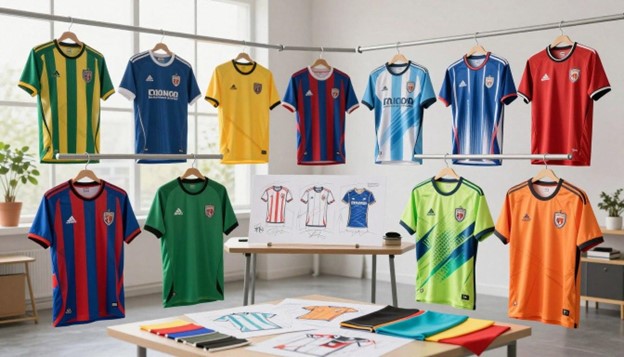
Finding the right kit for a team is crucial. It helps establish a professional identity on the field. During the 2026 season, teams will want to stand out whether they are competing in a local league, school competition, academy, or major tournament.
A well-planned uniform does more than look attractive. It gives players a consistent team identity and makes names, numbers, colors, and branding easier to recognize across the pitch.
Modern customization options have expanded significantly. Teams can now combine classic stripes, minimalist layouts, gradients, geometric patterns, sponsor placement, custom numbers, and performance fabrics without being limited to a few stock designs.
Exploring different aesthetics is important, but comfort and functionality should remain part of the decision. A strong jersey design needs to look professional while allowing players to run, turn, stretch, and compete comfortably for a full match.
Teams ready to turn inspiration into an actual kit can explore the Sports Custom Uniform soccer jersey collection for customizable soccer jersey options.

Innovative Trends in Soccer Jersey Design
Recent advances in sportswear fabrics and digital printing have changed both the look and feel of soccer uniforms.
Modern jerseys commonly use 100% polyester or polyester-based performance fabrics because they can provide a useful combination of low weight, moisture management, durability, and breathability.
Sports Custom Uniform's current custom soccer products list fabric options such as 100% polyester, Bird Eye Mesh, interlock, and microfiber, with breathable, moisture-wicking, lightweight, and stretch-oriented properties.
Modern soccer jersey design is also moving in several visual directions:
- Clean, minimalist layouts
- Strong color blocking
- Retro-inspired patterns
- Subtle tonal graphics
- Geometric textures
- Gradients
- High-contrast numbers
- Custom collar and sleeve treatments
- Integrated sponsor branding
The international kit market continues to influence team design. Professional clubs increasingly use jerseys to tell stories about their cities, anniversaries, history, and supporter culture rather than treating each shirt as just another color variation.
For 2026 specifically, FIFA has emphasized that kit design involves more than aesthetics. For the 2026 World Cup, its review process considers primary and alternate color combinations, emblem sizing, and the design and visibility of player names and numbers.
See how FIFA approaches World Cup 2026 kit design
Soccer Jersey Design Ideas for Every Team
The right apparel can unify a team's visual identity. Balancing traditional aesthetics with contemporary elements is often the best way to create a kit that feels distinctive without looking outdated after one season.
1. Build Around Your Club Colors
Start with the colors people already associate with your club.
A practical system usually includes:
- Primary color: dominant jersey color
- Secondary color: supports panels, sleeves, or shorts
- Accent color: used sparingly for trims, numbers, or logos
You do not need five equally dominant colors to make a jersey memorable. Often, a restrained palette produces a stronger identity.
2. Use Classic Stripes With a Modern Twist
Vertical or horizontal stripes remain effective because they are instantly recognizable.
Instead of copying a traditional striped kit exactly, consider:
- Uneven stripe widths
- Tonal stripes
- Faded stripes
- Offset stripe placement
- A subtle pattern inside the stripe
- Stripes that continue into sleeves or shorts
3. Try High-Contrast Color Blocking
Large blocks of contrasting color can create a modern, athletic look without overcrowding the jersey.
This is particularly effective when one section helps frame the:
- Club crest
- Player number
- Sponsor
- Sleeve details
4. Add a Subtle Pattern
Patterns can add personality without overwhelming the shirt.
Ideas include:
- Geometric shapes
- Tonal club initials
- Local landmarks
- Mascot-inspired textures
- Map contours
- Cultural symbols
- Repeating crest elements
With sublimation, these elements can be incorporated directly into the overall design rather than added as thick surface graphics.
5. Keep Sponsor Logos Integrated
Sponsor logos should be clearly visible without overpowering the team's identity.
Placement, scale, contrast, and available negative space matter. Your club crest and core colors should still feel like the primary visual elements.
6. Make Player Names and Numbers Easy to Read
Adding names and numbers is standard practice, but legibility should come before decorative complexity.
Use:
- Clear number shapes
- Strong contrast
- Adequate spacing
- Consistent placement
- A font that remains readable from distance
The design should work from the stands, not only when viewed close-up on a screen.

Analyzing the Best Jersey Designs From Past Seasons
Looking at successful professional kits can reveal why certain designs remain memorable.
The goal is not to copy professional clubs. It is to understand what design principle made their kit work.
Ajax: Turning Local History Into a Design Story
Ajax's 2025/26 third shirt celebrated Amsterdam's 750th anniversary.
The official club explanation says the beige base drew inspiration from the oldest document referencing Amsterdam, while the interior neck incorporated a modern version of the city's historic seal. The kit also included the classic Ajax crest and references to 1275 and 2025.
See the official Ajax 2025/26 third-kit story
Design lesson: Your team's geography or history can inspire a pattern without turning the entire shirt into a literal illustration.
Bayern Munich: Anniversary Design Without Looking Old
Bayern Munich's 125th-anniversary jersey combined club history with a contemporary finish.
Its deep traditional red, gold detailing, anniversary crest, and references to the club's historic home grounds created a heritage-driven kit that still looked current.
See FC Bayern's official 125th-anniversary jersey
Design lesson: Heritage can come through typography, color, crest details, and subtle patterns rather than simply recreating an old uniform.
Club América: Reworking a Recognizable Past Design
Club América's 2025/26 home jersey marked the club's return to adidas and reinterpreted a memorable 1990s-era partnership. Adidas describes the design as a modern take on an iconic previous kit, using eagle-feather-inspired graphics and a centered crest.
See the Club América 2025/26 jersey
Design lesson: Retro inspiration works best when it is reinterpreted rather than duplicated.

Designing Your Own Custom Soccer Kit
Creating a personalized kit becomes much easier when the process follows a clear order.
Instead of choosing random graphics first, build the identity systematically.
Step 1: Select the Base Style
Choose a silhouette that works for your team.
Consider:
- Crew neck
- V-neck
- Collar
- Raglan sleeve
- Traditional short sleeve
- Contemporary athletic cut
Step 2: Define the Color Palette
Set the primary, secondary, and accent colors before adding patterns.
This helps prevent a design from becoming visually inconsistent.
Step 3: Add Patterns and Graphics
Now decide whether the jersey needs:
- Stripes
- Gradients
- Geometric artwork
- Tonal patterns
- Mascot details
- City references
- Abstract textures
Step 4: Position the Club Crest
The club logo should remain clear and recognizable.
Avoid placing complex background patterns directly behind it unless sufficient contrast is maintained.
Step 5: Add Sponsor Branding
Keep sponsors integrated with the existing layout rather than designing the rest of the shirt around the sponsor alone.
Step 6: Add Player Names and Numbers
Check:
- Spelling
- Number assignment
- Font
- Contrast
- Size
- Placement
before approving production.
Step 7: Confirm Player Sizes
Use an accurate size chart and collect the roster information before final approval.
Different players may require different sizes or cuts, so do not assume one standard fit works for everyone.
Step 8: Review the Mockup Before Production
Sports Custom Uniform's current custom soccer process includes preparing a 3D or flat mockup for approval before the uniform moves through fabric selection, printing, cutting, stitching, finishing, and delivery.
The Custom Soccer Uniform Set is the most relevant targeted product page for this article because it supports custom team names, player numbers, logos, sponsors, colors, fabric selection, and sublimated production.
For a deeper walkthrough of the online design workflow, read Step-by-Step: How to Build Your Own Uniform Online.

Tips for Including Player Names, Numbers, and Logos
Small details often determine whether a custom soccer jersey looks professional or unfinished.
Keep Numbers Highly Visible
Player numbers should have enough contrast against the background.
Avoid using a dark navy number over a black patterned area or a pale number over a white gradient without an outline.
Use One Typography System
Too many unrelated fonts weaken the overall identity.
A cleaner approach might use:
- One display font for the team
- One clear font for player names
- Matching or complementary numbers
Give the Club Logo Breathing Room
Do not crowd the crest with sponsor marks, textures, and seams.
Negative space around the emblem improves recognition.
Be Consistent Across the Roster
Every jersey should use the same:
- Logo scale
- Number placement
- Font
- Sponsor position
- Color treatment
- Sleeve detailing
Only player-specific details should change.
Review the Design as a Complete Kit
Do not assess the jersey alone.
Check how it works with:
- Shorts
- Socks
- Goalkeeper uniform
- Warm-up gear
A striking jersey paired with unrelated shorts can weaken the whole look.
| Feature | Recommended Approach | Benefit |
|---|---|---|
| Mockup Preview | Review the complete design before production | Helps catch layout errors |
| Player Details | Confirm names and numbers from final roster | Reduces production mistakes |
| Logo Placement | Keep size and position consistent | Stronger team branding |
| Sizing | Use the correct size chart for every player | Better comfort and fit |
2026 Soccer Jersey Design Ideas Worth Trying
Teams looking for something current without chasing a short-lived trend can explore several directions.
Minimalist Base With One Bold Detail
Use a clean body color and make one element memorable, such as:
- Contrasting sleeves
- Oversized side panel
- Strong collar
- Tonal crest pattern
Retro-Inspired Geometry
Bring back 1990s-style energy through modern sublimation rather than copying an old professional jersey.
Tonal Monogram Patterns
Repeat the team initials or emblem subtly across the fabric.
From a distance, the jersey remains clean. Up close, the detail becomes visible.
Gradient Side Panels
Gradients work particularly well when confined to a controlled area instead of covering the entire uniform.
Local Storytelling
A city skyline, state outline, landmark shape, or regional symbol can make a generic template feel uniquely connected to the team.
Dark Home, Light Away System
If your competition uses home and away kits, design them as one family.
Keep consistent:
- Typography
- Crest treatment
- Pattern language
- Number style
while changing the dominant colors.
The broader 2026 uniform landscape is also moving toward a mix of retro influences, high contrast, streamlined branding, and modern sublimation. Sports Custom Uniform discusses those directions further in Top Trends in Team Uniform Design for 2026.
That is the second previous relevant blog for this article.
Choosing the Right Fabric and Fit
Great soccer jersey design ideas still fail if the garment feels uncomfortable during play.
A good soccer jersey should support:
- Continuous running
- Fast directional changes
- Arm movement
- Sweat management
- Match-length comfort
Sports Custom Uniform's soccer products list common options including:
- 100% polyester
- Bird Eye Mesh
- Interlock
- Microfiber
The appropriate choice depends on climate, budget, desired feel, and level of competition.
For hot-weather teams, prioritize lightweight, breathable construction.
For teams competing in cooler environments, layering can usually provide warmth more effectively than making the game jersey unnecessarily heavy.
Women's and youth teams should also use sizing and cuts suited to their players rather than simply scaling one adult men's pattern up or down.

Conclusion
A thoughtfully designed soccer jersey helps create a consistent visual identity for the entire team.
The strongest designs usually start with a clear plan:
- Establish your team colors.
- Choose a recognizable visual direction.
- Build sufficient contrast.
- Add patterns with restraint.
- Keep names and numbers readable.
- Position logos and sponsors carefully.
- Choose performance fabric and an appropriate fit.
- Review a complete mockup before approving production.
Recent professional designs show that storytelling and historical references can make a jersey memorable. Ajax used Amsterdam's history, Bayern Munich celebrated 125 years of club identity, and Club América reinterpreted a recognizable 1990s-era look for a new generation.
Whether you're building uniforms for a local club, school, academy, competitive youth team, or adult league, the goal should be the same: create something distinctive enough to represent your identity without sacrificing comfort or functionality.
When you're ready to turn the concept into an actual kit, Sports Custom Uniform offers customizable soccer jerseys, team uniforms, colors, logos, player details, and design support.
Frequently Asked Questions
What materials are commonly used for soccer kits?
Modern soccer jerseys commonly use polyester and polyester-based performance fabrics because they are lightweight, durable, quick-drying, and compatible with moisture-management technologies.
Sports Custom Uniform also lists Bird Eye Mesh, interlock, and microfiber among its soccer uniform fabric options.
How can a team incorporate sponsor logos into its designs?
Place sponsor logos where they remain clearly visible without competing with the club crest, player number, or primary visual pattern.
Before production, check the rules of your specific league or competition because permitted advertising size and placement can vary.
What are the key elements to consider when designing a custom soccer kit?
Focus on:
- Color scheme
- Team identity
- Pattern
- Fabric
- Fit
- Club crest
- Sponsor placement
- Player names
- Numbers
- Shorts and socks
- Overall consistency
Are there specific trends in jersey design for women's teams?
Women's teams increasingly have access to dedicated cuts rather than simply smaller versions of men's jerseys.
The priority should be an appropriate fit, full freedom of movement, breathable fabric, and the same level of customization available to the rest of the club.
How can teams ensure their jerseys fit all players comfortably?
Use the supplier's current size chart and collect measurements before placing the final order.
If men's, women's, and youth cuts are available, select the appropriate cut for each player rather than using one universal fit.
What is the importance of using a 3D configurator or digital mockup?
A digital or 3D mockup lets the team see how colors, patterns, numbers, sponsor logos, and other details work together before production.
It also gives coaches and team managers an opportunity to identify spelling, layout, and color problems before the uniforms are printed and assembled.


